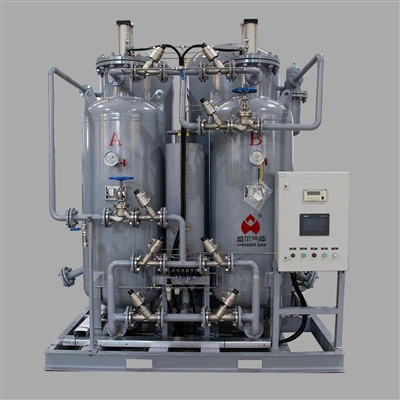
As a supplier of PSA Oxygen Plants, I understand the significance of optimizing operation parameters to ensure the efficiency, reliability, and cost - effectiveness of these plants. In this blog, I will discuss key aspects of optimizing the operation parameters of a PSA oxygen plant.
I. Understanding PSA Oxygen Plants
PSA (Pressure Swing Adsorption) oxygen plants are widely used in various industries, such as medical, metal cutting, and chemical production. The basic principle of a PSA oxygen plant is to separate oxygen from air by using adsorbents that selectively adsorb nitrogen at high pressure and release it at low pressure.
The main components of a PSA oxygen plant include an air compressor, air pretreatment system, adsorption columns, and control system. The air compressor compresses the ambient air, and the air pretreatment system removes moisture, oil, and dust from the compressed air. The adsorption columns are filled with adsorbents, usually zeolite molecular sieves, which adsorb nitrogen and allow oxygen to pass through. The control system manages the pressure swing process and ensures the stable operation of the plant.
II. Key Operation Parameters and Their Optimization
1. Pressure
- Adsorption Pressure: The adsorption pressure affects the adsorption capacity of the adsorbent. Generally, a higher adsorption pressure leads to a greater adsorption capacity of nitrogen on the adsorbent. However, increasing the adsorption pressure also requires more energy for compression. Therefore, an optimal adsorption pressure needs to be determined based on the specific requirements of the plant. For most PSA oxygen plants, the adsorption pressure ranges from 0.6 - 1.0 MPa.
- Desorption Pressure: The desorption pressure is crucial for the regeneration of the adsorbent. A lower desorption pressure helps to release the adsorbed nitrogen more effectively. In practice, the desorption pressure is usually close to atmospheric pressure or slightly lower. Some advanced PSA oxygen plants use vacuum desorption to improve the regeneration efficiency, which is known as VPSA (Vacuum Pressure Swing Adsorption). You can learn more about Vpsa Oxygen Plant on our website.
2. Cycle Time
The cycle time of a PSA oxygen plant refers to the time for one complete adsorption - desorption cycle. It includes the adsorption time, equalization time, and desorption time.
- Adsorption Time: If the adsorption time is too short, the adsorbent may not be fully utilized, resulting in a lower oxygen production rate. On the other hand, if the adsorption time is too long, the adsorbent may reach saturation, and the purity of the produced oxygen may decrease. The optimal adsorption time depends on factors such as the type of adsorbent, the flow rate of the feed air, and the desired oxygen purity.
- Equalization Time: The equalization time is used to balance the pressure between the adsorption columns. It helps to reduce the pressure fluctuations during the cycle and improve the stability of the plant operation. A proper equalization time can also enhance the utilization efficiency of the adsorbent.
- Desorption Time: Sufficient desorption time is necessary to ensure the complete regeneration of the adsorbent. However, an overly long desorption time may waste energy. Therefore, the desorption time should be optimized according to the desorption pressure and the characteristics of the adsorbent.
3. Feed Air Flow Rate
The feed air flow rate is an important parameter that affects the oxygen production capacity of the PSA oxygen plant. A higher feed air flow rate can increase the oxygen production rate, but it may also reduce the oxygen purity if the adsorbent cannot effectively adsorb nitrogen at a high flow rate. The optimal feed air flow rate should be determined based on the design capacity of the plant, the type of adsorbent, and the desired oxygen purity.
4. Temperature
The temperature of the feed air and the adsorbent has an impact on the adsorption performance. Generally, a lower temperature is beneficial for nitrogen adsorption because the adsorption capacity of the adsorbent increases with decreasing temperature. However, maintaining a very low temperature requires additional energy for cooling. Therefore, a suitable temperature range should be maintained. Usually, the feed air temperature is controlled between 5 - 40 °C.
III. Monitoring and Adjusting Operation Parameters
To optimize the operation parameters of a PSA oxygen plant, continuous monitoring and adjustment are necessary.
- Online Monitoring: Install sensors to monitor key parameters such as pressure, flow rate, temperature, and oxygen purity. The data collected from these sensors can be used to analyze the operation status of the plant in real - time.
- Automated Control System: An automated control system can adjust the operation parameters based on the monitored data. For example, if the oxygen purity decreases, the control system can adjust the adsorption time or the feed air flow rate to improve the purity.
- Regular Maintenance and Calibration: Regular maintenance of the PSA oxygen plant is essential to ensure the accuracy of the sensors and the proper operation of the equipment. Calibration of the sensors should be carried out periodically to ensure the reliability of the monitoring data.
IV. Case Studies
Let's take a medical oxygen generation plant as an example. In a hospital, a PSA oxygen plant is used to provide oxygen for patients. The initial operation parameters of the plant were set based on the design requirements. However, after a period of operation, it was found that the oxygen purity was slightly lower than the required level.
By analyzing the operation data, it was found that the adsorption time was too long, which led to the saturation of the adsorbent. The operation parameters were adjusted by reducing the adsorption time and increasing the equalization time. After the adjustment, the oxygen purity increased to the required level, and the energy consumption of the plant also decreased. You can learn more about Medical Oxygen Generation System on our website.


Another case is a metal cutting oxygen plant. The plant was facing problems such as unstable oxygen flow rate and high energy consumption. After a detailed analysis, it was found that the feed air flow rate was not properly adjusted, and the desorption pressure was too high. By optimizing the feed air flow rate and reducing the desorption pressure, the plant's performance was significantly improved.
V. Conclusion
Optimizing the operation parameters of a PSA oxygen plant is a complex but crucial task. By carefully adjusting parameters such as pressure, cycle time, feed air flow rate, and temperature, we can improve the oxygen production efficiency, enhance the oxygen purity, and reduce the energy consumption of the plant.
As a PSA Oxygen Plant supplier, we are committed to providing high - quality products and professional technical support. If you are interested in our Oxygen Making Machine Plant or have any questions about optimizing the operation parameters of PSA oxygen plants, please feel free to contact us for further discussion and procurement negotiation.
References
- Ruthven, D. M., Farooq, S., & Knaebel, K. S. (1994). Pressure swing adsorption. VCH Publishers.
- Yang, R. T. (2003). Gas separation by adsorption processes. World Scientific.