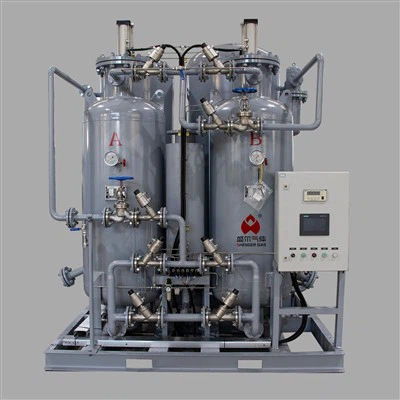
Hey there! As a supplier of PSA Nitrogen Plants, I've been getting a lot of questions lately about how to ensure low particle content in the nitrogen produced by these plants. So, I thought I'd share some tips and insights on this topic.


First off, let's understand why low particle content is so important. Nitrogen is used in a wide range of industries, from food packaging to electronics manufacturing. In many of these applications, even a small amount of particles in the nitrogen can cause problems. For example, in the electronics industry, particles can contaminate sensitive components, leading to malfunctions or reduced product lifespan. In food packaging, particles can affect the quality and safety of the food.
So, how can we ensure low particle content in the nitrogen of a PSA nitrogen plant? Here are some key steps:
1. High - Quality Air Intake Filtration
The air that goes into the PSA nitrogen plant is the starting point. If the incoming air is full of particles, it's going to be a challenge to get clean nitrogen. That's why using high - quality air intake filters is crucial. These filters should be able to trap a wide range of particle sizes, from large dust particles to tiny aerosols.
There are different types of air intake filters available, such as pre - filters and HEPA (High - Efficiency Particulate Air) filters. Pre - filters are used to remove larger particles, while HEPA filters can capture very fine particles, often down to 0.3 microns. By using a combination of these filters, you can significantly reduce the particle load in the incoming air.
2. Regular Maintenance of Filters
Just installing high - quality filters isn't enough. You need to maintain them regularly. Over time, filters can get clogged with particles, which reduces their efficiency. This can lead to an increase in particle content in the nitrogen. So, it's important to have a maintenance schedule in place.
Check the filters regularly to see if they need to be cleaned or replaced. The frequency of maintenance depends on the operating conditions of the PSA nitrogen plant. For example, if the plant is located in a dusty environment, the filters may need to be replaced more often.
3. Proper PSA Bed Design and Operation
The PSA (Pressure Swing Adsorption) beds are at the heart of the nitrogen generation process. The design of these beds can have a big impact on particle content. A well - designed PSA bed should be able to separate nitrogen from other gases effectively while minimizing the carry - over of particles.
During operation, it's important to control the pressure and flow rates carefully. If the pressure is too high or the flow rate is too fast, it can cause particles to be carried through the system. On the other hand, if the pressure is too low or the flow rate is too slow, the nitrogen production efficiency may be reduced.
4. Post - Treatment Filtration
Even with good air intake filtration and proper PSA bed operation, there may still be some particles in the nitrogen. That's where post - treatment filtration comes in. After the nitrogen is generated, it can pass through additional filters to remove any remaining particles.
These post - treatment filters can be similar to the air intake filters, but they may need to be even more efficient to ensure the lowest possible particle content. Some advanced post - treatment filters can remove particles as small as 0.01 microns.
5. Monitoring and Quality Control
To ensure that the nitrogen has low particle content, you need to monitor it regularly. There are various particle counters available that can measure the number and size of particles in the nitrogen. By regularly monitoring the particle content, you can detect any issues early and take corrective actions.
Quality control also involves setting standards for particle content. Different industries may have different requirements for the maximum allowable particle content in nitrogen. Make sure you know the standards for your specific application and ensure that your PSA nitrogen plant meets them.
Now, let's talk about some of the products we offer as a PSA Nitrogen Plant supplier. We have a range of nitrogen generators to suit different needs. If you're looking for a small - scale solution, our Small Nitrogen Gas Generator is a great option. It's compact and efficient, perfect for laboratories or small - scale industrial applications.
For those in the automotive industry, our Tire Nitrogen Generator is designed specifically for filling car tires with nitrogen. It can produce high - purity nitrogen with low particle content, ensuring the safety and performance of your tires.
And if you need an even more compact solution, our Small Nitrogen Generator is the way to go. It's easy to install and operate, making it ideal for small businesses or home workshops.
If you're interested in any of our products or have questions about ensuring low particle content in your nitrogen supply, don't hesitate to reach out. We're here to help you find the best solution for your needs. Whether you're a small business or a large industrial operation, we have the expertise and products to meet your requirements.
In conclusion, ensuring low particle content in the nitrogen of a PSA nitrogen plant requires a combination of high - quality filtration, proper maintenance, and careful operation. By following these steps and using the right products, you can get clean, particle - free nitrogen for your applications.
References:
- "Industrial Gas Handbook: Gas Separation and Purification" by Angelo A. Benedetti
- "Pressure Swing Adsorption" by Douglas M. Ruthven, Sabine Farooq, and K. S. Knaebel