Hey there! As a supplier of PSA Oxygen Plants, I often get asked about how the adsorbent regeneration process works in these plants. So, I thought I'd take a few minutes to break it down for you in a way that's easy to understand.
First off, let's talk a bit about what a PSA (Pressure Swing Adsorption) oxygen plant is. It's a system that separates oxygen from other gases in the air, mainly nitrogen, to produce high - purity oxygen. This is super useful in a bunch of industries, like healthcare, metal fabrication, and water treatment.
The heart of a PSA oxygen plant is the adsorbent material. Usually, zeolite molecular sieves are used as adsorbents. These materials have tiny pores that can trap certain molecules based on their size and shape. In the case of PSA oxygen plants, the zeolite adsorbs nitrogen more readily than oxygen.
The Basic PSA Cycle
The PSA process works in a cycle that consists of two main phases: adsorption and regeneration.
Adsorption Phase
During the adsorption phase, compressed air is fed into one of the adsorption vessels filled with the adsorbent. The adsorbent selectively adsorbs nitrogen molecules from the air, allowing oxygen to pass through and be collected as the product gas. This is how we get that high - purity oxygen we're after. The pressure inside the vessel is kept relatively high during this phase, which helps the adsorbent do its job more effectively.
Let's say you're looking for a reliable oxygen source. Our Oxygen Gas Generator can be a great option. It uses the PSA technology to produce oxygen efficiently.
Regeneration Phase
Now, here's where the adsorbent regeneration process comes in. After a while, the adsorbent gets saturated with nitrogen. If we don't do anything about it, it won't be able to adsorb more nitrogen, and the oxygen production will drop. So, we need to regenerate the adsorbent.
There are a few ways to regenerate the adsorbent in a PSA oxygen plant, but the most common method is pressure reduction.
Pressure Reduction Regeneration
When the adsorption phase is over, the pressure in the adsorption vessel is reduced. This reduction in pressure causes the nitrogen molecules that were adsorbed onto the adsorbent to desorb. It's like releasing the trapped nitrogen from the tiny pores of the zeolite.
The pressure is usually reduced to near - atmospheric pressure. As the pressure drops, the equilibrium between the adsorbed nitrogen and the gas phase shifts, and the nitrogen starts to leave the adsorbent surface. The desorbed nitrogen is then vented out of the vessel.
Once the nitrogen is removed, the adsorbent is ready to go through another adsorption cycle. The vessel is then repressurized, and the adsorption process starts all over again.
Purge Gas Regeneration
In some cases, a purge gas is used to enhance the regeneration process. A small amount of the produced oxygen can be used as the purge gas. The purge gas is passed through the adsorbent bed in the opposite direction of the feed air flow during the adsorption phase.
The purge gas helps to carry away the desorbed nitrogen more effectively. It sweeps through the adsorbent bed, pushing the nitrogen out of the vessel. This method can improve the regeneration efficiency and reduce the time needed for the adsorbent to be fully regenerated.
If you're in the market for a high - purity oxygen solution, our Oxygen Generator 95% Purity might be just what you need. It uses advanced PSA technology with efficient adsorbent regeneration to ensure a continuous supply of high - quality oxygen.
Dual - Bed PSA System
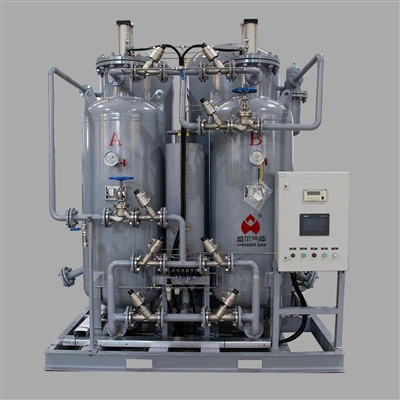
Most PSA oxygen plants use a dual - bed system. This means there are two adsorption vessels. While one vessel is in the adsorption phase, producing oxygen, the other is in the regeneration phase. This allows for a continuous production of oxygen.
When the first vessel's adsorbent gets saturated, the flow of compressed air is switched to the second vessel, which has just been regenerated. At the same time, the first vessel starts the regeneration process. This alternating cycle ensures that there's always a source of high - purity oxygen available.
Portable PSA Oxygen Concentrators
For some applications, like in the healthcare field, portable PSA oxygen concentrators are used. These are smaller, more compact versions of the PSA oxygen plants. Take the Inogen Portable Oxygen Concentrator for example.
The adsorbent regeneration process in portable concentrators works on the same principle as in larger PSA plants. However, they are designed to be more energy - efficient and lightweight. The pressure reduction and purge gas methods are also used to regenerate the adsorbent, but the components are optimized for portability.
Factors Affecting Adsorbent Regeneration
There are a few factors that can affect how well the adsorbent regeneration process works.
Pressure Swing
The magnitude of the pressure swing between the adsorption and regeneration phases is crucial. A larger pressure swing generally leads to more efficient desorption of nitrogen. But we also need to balance this with the energy requirements of the system.


Temperature
Temperature can also play a role. Higher temperatures can increase the rate of desorption, but it also requires more energy to heat the system. Most PSA oxygen plants operate at near - ambient temperatures to keep the energy consumption down.
Adsorbent Characteristics
The type and quality of the adsorbent are important. Different adsorbents have different adsorption and desorption properties. Zeolite molecular sieves are commonly used because they have good selectivity for nitrogen and can be regenerated relatively easily.
Why Choose Our PSA Oxygen Plants
We've been in the business of supplying PSA oxygen plants for a long time. Our plants are designed with the latest technology to ensure efficient adsorbent regeneration. This means you get a continuous supply of high - purity oxygen with minimal downtime.
Our team of experts can also provide you with customized solutions based on your specific needs. Whether you need a large - scale industrial oxygen plant or a small portable concentrator, we've got you covered.
If you're interested in learning more about our PSA oxygen plants or have any questions about the adsorbent regeneration process, don't hesitate to reach out. We're here to help you make the right choice for your oxygen supply needs. Contact us to start a procurement discussion and find out how we can meet your requirements.
References
- Ruthven, D. M., Farooq, S., & Knaebel, K. S. (1994). Pressure Swing Adsorption. John Wiley & Sons.
- Yang, R. T. (1987). Gas Separation by Adsorption Processes. Butterworths.