


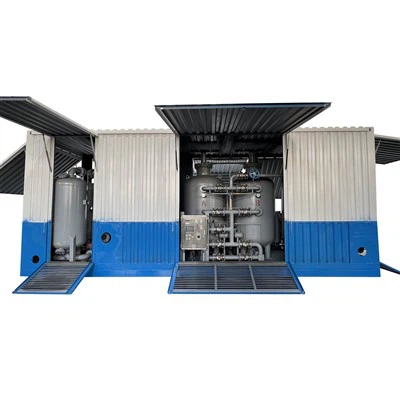
Small Industrial Nitrogen Generator
In precision manufacturing, laser cutting, chemical intermediate tank blanketing, and pharmaceutical packaging, on-site nitrogen generation is steadily replacing traditional liquid nitrogen dewars and high-pressure cylinder supplies. The core reasons are straightforward: eliminate logistics dependence, reduce long-term operating costs, and gain real-time control over nitrogen purity and pressure. A properly specified small industrial nitrogen generator can deliver stable nitrogen output that matches process requirements without relying on external gas sources.
Core Separation Principle and Technical Path
For small to medium flow applications, the most mature technology is Pressure Swing Adsorption (PSA). The physical basis lies in the difference in adsorption rates between oxygen and nitrogen on carbon molecular sieves - oxygen molecules have a slightly smaller kinetic diameter, making them more likely to enter the sieve micro-pores and be adsorbed, while nitrogen passes through the sieve bed relatively quickly and becomes enriched at the outlet. The process uses two alternating adsorption towers: one adsorbs under pressure to produce nitrogen, while the other regenerates the molecular sieve under atmospheric pressure. The cycle typically lasts from several tens of seconds to a few minutes, enabling continuous gas production.
For scenarios requiring purity no higher than 99.9% with intermittent flow fluctuations, PSA offers lower overall energy consumption and better purity stability compared to membrane separation technology.
Technical Parameters and Performance Specifications
The table below summarizes the key design parameters for a typical small industrial nitrogen generator, covering standard industrial operating conditions:
|
Parameter |
Typical Range |
Technical Notes |
|---|---|---|
|
Nitrogen Purity |
95% ~ 99.999% |
Adjustable via cycle time and sieve loading |
|
Flow Rate |
1 ~ 200 Nm³/h |
Small units typically ≤50 Nm³/h |
|
Dew Point |
-40℃ ~ -70℃ |
Requires refrigerated air dryer + adsorption dryer |
|
Inlet Air Pressure |
6 ~ 10 bar(g) |
Oil-free compressed air required, oil content ≤0.01ppm |
|
Ambient Operating Temp |
5℃ ~ 45℃ |
Ambient modifications needed outside this range |
|
Specific Energy Consumption |
0.25 ~ 0.45 kWh/Nm³ |
Typical value at 99.5% purity, room temperature |
|
Noise Level |
≤75 dB(A) @1m |
With silencer and acoustic enclosure |
Energy consumption and purity are closely linked: raising purity from 99% to 99.999% can double or even triple the compressed air consumption. Therefore, setting a reasonable purity target based on actual process needs is key to reducing operating costs - there's no need to chase excessively high purity numbers.
Industrial Applications and Technical Matching
This equipment is commonly found in the following process areas:
-
Laser cutting assist gas (oxidation prevention)
-
Chemical intermediate and solvent tank blanketing
-
Modified atmosphere packaging for food and moisture-proof production for pharmaceuticals
-
Lead-free reflow soldering for electronic components
-
Powder metallurgy and heat treatment protective atmospheres
What these applications share: moderate nitrogen usage, a need for continuous and stable supply, and no on-site conditions for a large air separation plant. A small industrial nitrogen generator - typically occupying less than 2 square meters of floor space - can deliver plug-and-play operation and on-demand gas production.
Design, Certifications, and Standards
The equipment is manufactured in accordance with the following technical standards:
-
Pressure vessels designed and inspected to GB/T 150 or ASME Section VIII (export configurations)
-
Electrical safety compliant with IEC 60204-1 or NFPA 79
-
Full CE marking (including LVD and EMC directives)
-
Molecular sieve material meeting ISO 5918 requirements
-
Nitrogen outlet cleanliness meeting ISO 8573-1 Class 1.2.1 (particulates, water content, total oil content)
For projects destined for different regions, additional certification packages such as UKCA and EAC can be provided to meet local regulatory requirements.
Customization Capabilities: From Sizing to Interface Integration
Customization goes beyond simple dimensional adjustments. We break it down into three practical delivery dimensions:
-
Purity/Flow Curve Customization: Based on your daily peak demand, duration, and fluctuation patterns, we redesign the adsorption tower dimensions and valve timing - avoiding the efficiency losses that come with generic models.
-
Environmental Adaptations: For hot and humid regions, we add pre-cooling units and high-efficiency oil removal filters. For cold climates, electric heat tracing and temperature control enclosures are available. For high-dust environments, intake pre-treatment is reinforced.
-
Communications and System Integration: Support for Modbus RTU/TCP, Profibus, and EtherNet/IP protocols allows seamless integration with existing PLC or SCADA systems for remote monitoring and data acquisition.
Service Framework and Long-Term Maintenance Support
Equipment delivery is not the end of the road - it is an extension of the technical engagement. Starting from the selection phase, we assist with complete calculations covering the air compressor, receiver tank, dryer, and pipe sizing. Upon arrival, a bilingual (English/Chinese) operation and maintenance manual is provided, and remote commissioning or on-site startup support is arranged based on project requirements.
Standard after-sales terms include:
-
12 to 24 months warranty on main components (depending on project configuration)
-
Molecular sieve service life guaranteed ≥5 years
-
Lifetime spare parts supply and technical consultation
Routine maintenance considerations: check pneumatic valve seals periodically (recommended every 2,000 to 4,000 hours), replace pre-filters according to actual operating conditions, and verify zero drift of the dew-point meter and oxygen analyzer at least once per year.
In the field of small industrial nitrogen generator systems, Shenger Gas provides not just equipment, but a complete technical fit from compressed air purification to nitrogen distribution at the point of use. Whether you are introducing on-site gas generation for the first time or replacing an existing unstable nitrogen supply, we can provide the corresponding equipment configuration and energy consumption estimates based on your actual flow curve and purity requirements - ensuring every unit runs reliably at the process level.


Hot Tags: small industrial nitrogen generator, China small industrial nitrogen generator manufacturers, suppliers, factory
You Might Also Like




Send Inquiry