


Pressure Swing Adsorption Nitrogen Generator
When an industrial site requires nitrogen, the typical choice is between liquid nitrogen delivery or on-site generation. A pressure swing adsorption nitrogen generator falls into the latter category. It separates nitrogen from compressed air using the difference in adsorption rates of oxygen and nitrogen on carbon molecular sieve under varying pressure levels.
Operating Principle
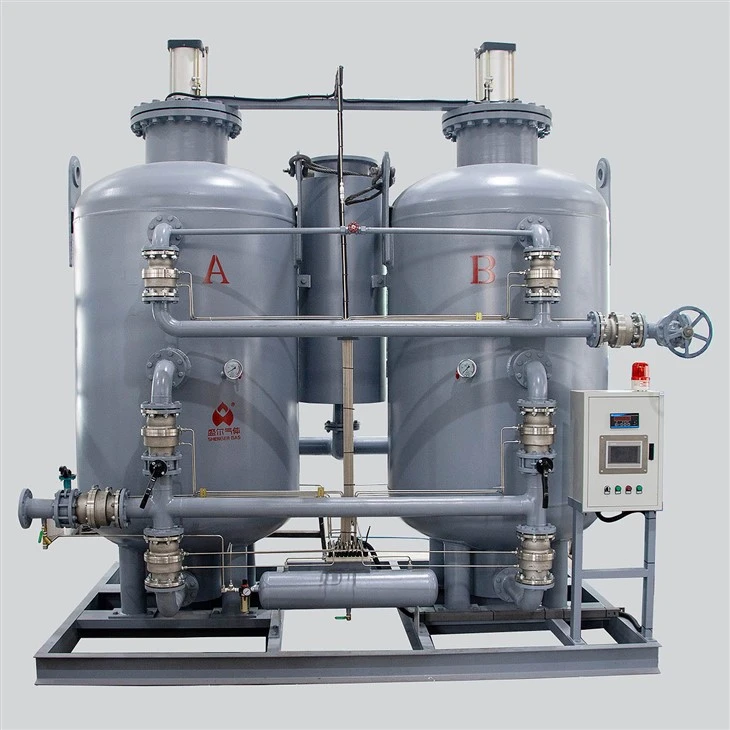
The core of the system consists of two adsorption towers filled with carbon molecular sieve. The process runs as follows:
1. Adsorption phase: Compressed air enters one tower at 0.6–0.8 MPa. Oxygen, water vapor, and carbon dioxide are preferentially adsorbed due to the molecular sieve's pore structure. Nitrogen - having a slightly larger molecular diameter - passes through the bed and exits the outlet line.
2. Regeneration phase: Before the tower reaches saturation, the system switches to the second tower. The saturated tower is depressurized to atmospheric pressure, releasing the adsorbed gases. The molecular sieve regenerates its adsorption capacity.
3. Cycle time: The two towers alternate between adsorption and regeneration, typically every 60 to 120 seconds. No chemical reactions occur. No continuous rotating parts are involved - the only moving components are control valves and the PLC.
The actual performance of a pressure swing adsorption nitrogen generator depends on three factors: dynamic adsorption capacity of the molecular sieve, valve switching response time, and the quality of incoming air pretreatment.
Performance Limits and Constraints
Values listed below are based on actual operating data, not theoretical maxima.
Parameter
| Typical Range
| Note
|
Nitrogen purity
| 95% – 99.999%
| Output drops significantly above 99.99%
|
Single-unit flow rate
| 5 – 3,000 Nm³/h
| Above this requires parallel units or custom towers
|
Outlet pressure
| 0.5 – 0.8 MPa
| Can be boosted to 15 MPa downstream
|
Atmospheric dew point
| -40°C to -60°C
| Down to -70°C with dryer module
|
Ambient temperature range
| 5°C – 45°C
| Requires temperature pretreatment outside this range
|
Specific energy consumption
| 0.18 – 0.35 kWh/Nm³
| At 99.5% purity, including air compressor
|
Three hard constraints:
1. Purity vs. output trade-off: Increasing purity from 99.5% to 99.999% reduces output by 40–60% and doubles energy consumption per Nm³. Select purity based on actual process needs - no unnecessary margin.
2. Inlet air quality requirement: Oil content ≤ 0.01 mg/m³, particle size ≤ 0.01 μm. Poor-quality air degrades molecular sieve capacity to below 60% within 6–12 months.
3. Temperature sensitivity: Below 5°C, dynamic adsorption capacity drops. Above 45°C, heat of adsorption accumulates, causing purity fluctuations of up to ±0.5%.
Technical Specifications (Reference Unit: 100 Nm³/h @ 99.5%)
Parameter
| Value
|
Rated nitrogen flow
| 100 Nm³/h
|
Purity range
| 99.5% – 99.99%
|
Outlet pressure
| 0.6 MPa
|
Number of adsorption towers
| 2
|
Valve cycle life
| ≥ 2 million cycles (pneumatic angle seat/butterfly valve)
|
Control system
| PLC + 7-inch HMI, Modbus RTU/TCP
|
Power consumption (excluding compressor)
| 0.8 kW
|
Dimensions (L × W × H)
| 2.6 × 1.8 × 2.2 m
|
Dry weight
| Approx. 1.8 metric tons
|
Note: Values measured at room temperature and standard atmospheric pressure. Flow rate correction factor is approximately 0.9 per 1,000 m altitude gain.
Typical Applications
This equipment is not industry-specific. It fits where the following conditions apply:
1. Monthly nitrogen consumption below 50,000 Nm³, and liquid nitrogen delivery costs exceed the depreciation plus energy cost of an on-site generator
2. Adjustable purity requirement - the site needs 95%, 99.9%, and 99.99% purity at different periods
3. No steam or high-temperature heat source available onsite (otherwise a non-PSA separation method may be preferable)
4. Continuous nitrogen supply is required, with automatic tower switching acceptable
When these conditions are met, the payback period for on-site generation is typically between 8 and 16 months. Outside this range, PSA is not recommended.
Certifications & Delivery
Standards
Pressure vessels: GB/T 150 or ASME Sec. VIII Div. 1. Safety: CE (PED 2014/68/EU), ISO 12100. Quality: ISO 9001; ISO 22000 optional for food-grade. Explosive atmospheres: ATEX Zone 2/22 optional.
Deliverables
FAT report (72h continuous run data), P&ID & electrical schematic, spare parts list with suppliers & model numbers, molecular sieve COA.
Customization & Maintenance
Customization Options
Explosion-proof (Ex d e mb)
Marine grade (class society certified)
High-altitude (>2,000 m; includes corrected flow curve)
Low dew point (-70°C)
Skid-mounted container type
Maintenance
Molecular sieve: 5–8 years design life; degradation depends on inlet air quality. Recommend outlet purity/dew point check every 2 years. Replacement based on degradation curve, not fixed schedule.
Valve seals: Inspect every 3–4 years.
PLC module: No routine maintenance; backup program required.
Spare parts lead time: Standard parts (valve seals, filter elements, PLC modules) shipped from domestic warehouse within 48 hours.
Shenger Gas supplies PSA nitrogen generators from 5 Nm³/h to 3,000 Nm³/h. No "lifetime maintenance-free" claims. Each unit includes its measured degradation curve. The control panel provides raw 90-day data: purity, flow rate, valve cycle counts. All specifications listed are supported by test records under relevant operating conditions.


Hot Tags: pressure swing adsorption nitrogen generator, China pressure swing adsorption nitrogen generator manufacturers, suppliers, factory
You Might Also Like


Send Inquiry