


Nitrogen Generator For Laser Welding
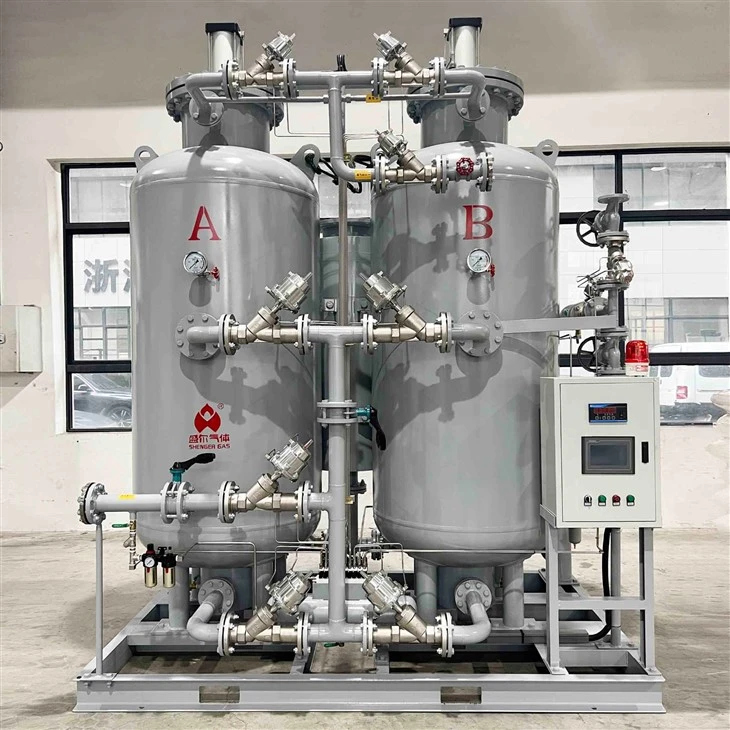
The nitrogen generator for laser welding is designed for production welding cells that require an on-site nitrogen supply from compressed air. The system uses PSA (pressure swing adsorption) with carbon molecular sieve to separate nitrogen from air. A standard configuration includes air filtration, air drying, adsorption towers, a buffer tank, nitrogen analyzer, flow control, and an outlet manifold.
Why nitrogen is used in laser welding
Laser welding of stainless steel, aluminum, and some carbon steels can be sensitive to oxygen. Nitrogen shielding helps reduce oxidation on the weld surface and can support stable melt-pool behavior in many applications. The gas flow must match nozzle diameter, laser power, weld speed, and joint design. Too low a flow may give poor coverage; too high a flow can cause turbulence and air entrainment. Local exhaust and proper cell ventilation are still needed. For critical welds, a weld trial is the practical way to confirm purity and flow settings.
Working principle and system configuration
The PSA unit alternates two adsorption beds. Compressed air passes through one bed while the other regenerates. A PLC controls valve switching, and the nitrogen analyzer monitors outlet purity. For laser welding, the nitrogen generator for laser welding is usually paired with a precision regulator, solenoid valve, flowmeter, and a dedicated line to the welding head. A small buffer tank helps reduce pressure fluctuation during the weld cycle. If the laser cell runs intermittent cycles, buffer volume and valve response should be checked together.
Typical technical specifications
| Parameter | Typical range |
|---|---|
| Nitrogen purity | 97–99.999% |
| Nitrogen flow | 5–200 Nm³/h |
| Outlet pressure | 0.5–0.8 MPa, adjustable |
| Dew point | -40°C to -60°C |
| Control | PLC/HMI, optional remote monitoring |
| Power supply | 380V/50Hz or project-specific |
| Compressed air quality | Dry, oil-free, filtered |
Selection notes
Selecting a nitrogen generator for laser welding requires more than a single flow figure. Buyers should confirm purity target, peak and average flow, pressure at the welding nozzle, duty cycle, ambient temperature, and available compressed air capacity. Stainless steel welding often calls for higher purity than some general shielding cases; the exact value should be verified by weld samples. Buffer tank size, pipe diameter, and pressure drop from the generator room to the laser cell also affect performance. Please provide a layout sketch and nozzle data for a more accurate configuration.
Maintenance and safety
Routine checks include filter replacement, analyzer calibration, valve inspection, and leak testing. The carbon molecular sieve should be protected from oil and water carryover. Nitrogen can displace oxygen in enclosed areas, so install an oxygen depletion monitor where required and follow lockout procedures during service. Operation manuals and training should be reviewed before start-up. A nitrogen generator for laser welding should be commissioned only after the compressed air supply has been verified for dew point, oil content, and particle filtration.
About Shenger Gas
Shenger Gas manufactures PSA nitrogen systems and related gas equipment for industrial users. For a nitrogen generator for laser welding, the team reviews gas demand, purity target, interface points, and site utilities, then proposes a configuration for technical review. Flow diagrams, operation manuals, and test records can be prepared for project approval.


Hot Tags: nitrogen generator for laser welding, China nitrogen generator for laser welding manufacturers, suppliers, factory
You Might Also Like


Send Inquiry