

In a compressed air system, the dryer is often the part people notice last. Many focus on the air compressor when sizing equipment and give less thought to the purification stage behind it. In practice, if moisture in compressed air is not handled properly, problems show up over time: corroded piping, sticking pneumatic components, unstable product quality. If the dryer itself is selected poorly, electricity and maintenance costs can quietly eat into profit. That is why the heat of compression desiccant dryer has drawn more attention across industries.
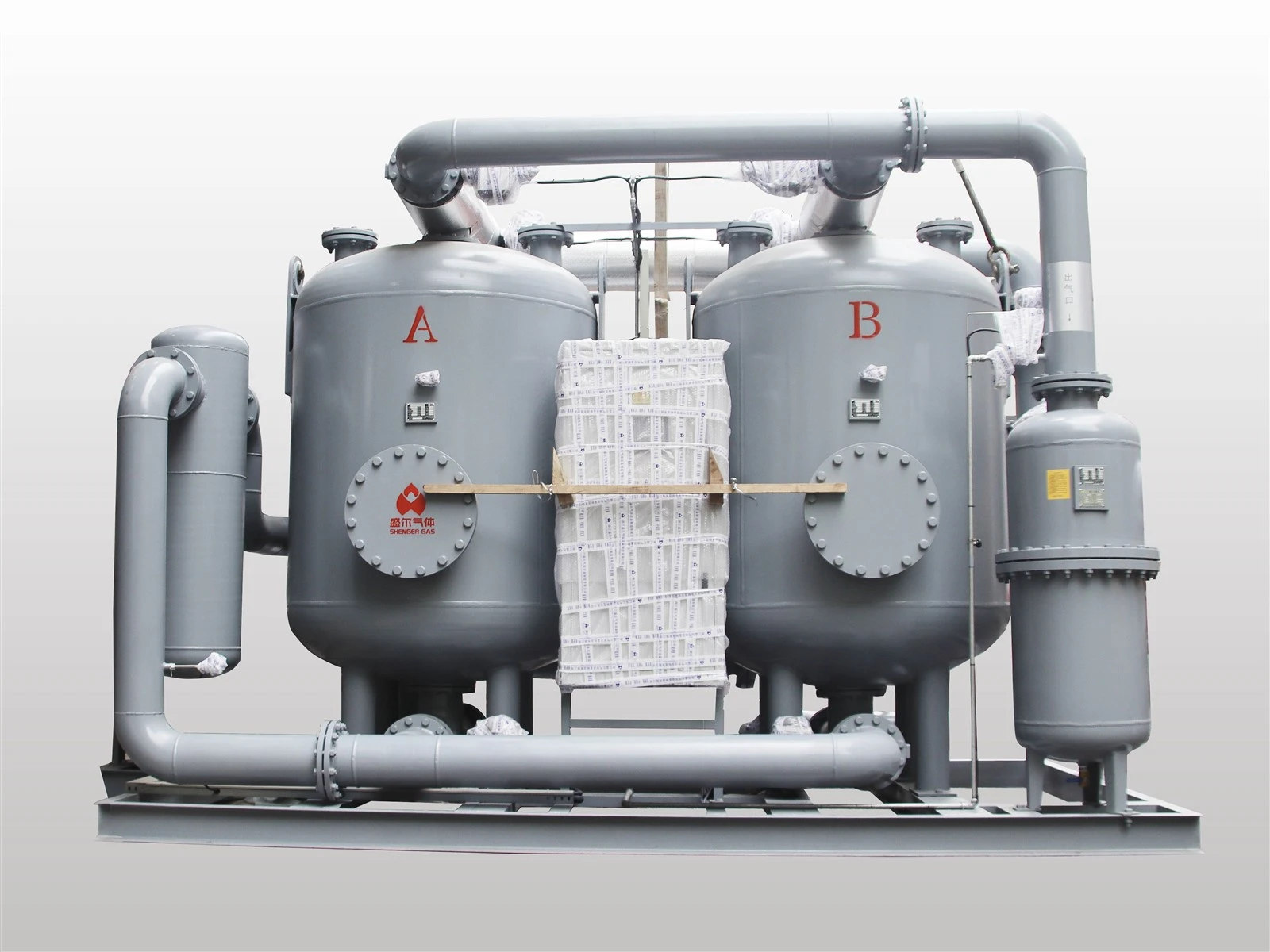
How a Heat of Compression Desiccant Dryer Works
To understand its energy-saving principle, it helps to start with the basic logic of a desiccant dryer. A desiccant dryer uses a drying agent-usually activated alumina or molecular sieve-to adsorb moisture from compressed air. Once the desiccant is saturated, it needs regeneration. The moisture must be driven off so the material can adsorb again.
In a conventional desiccant dryer, regeneration usually uses either a portion of already dried compressed air for purging or an electric heater to heat the regeneration gas. Both methods have a cost. The first wastes compressed air that could otherwise be used. The second consumes electricity directly. A heat of compression regenerative desiccant dryer takes a different route.
It uses heat generated during compression. When air is compressed, its temperature rises, and that heat would normally be rejected through a cooler. A heat-of-compression dryer captures this heat and uses it to heat the regeneration gas or directly heat the desiccant bed. As a result, the heat needed for regeneration no longer requires extra electricity or high-quality compressed air. It is recovered from inside the system. In simple terms, waste heat that would have been thrown away is put to work, reducing external energy input.
Where the Energy Savings Come From
The energy saving of a heat of compression desiccant dryer is not a single-point gain. It is an optimization at the system level. Because regeneration no longer depends on electric heaters, operating electricity costs drop noticeably. At the same time, since compression heat is used, regeneration air consumption is much lower than that of a traditional heatless desiccant dryer. For continuous operation with stable air demand, this saving shows up month after month on the energy bill.
One point that is often overlooked: heat of compression dryers usually offer good dew point stability. Since regeneration temperature comes from compression heat, the bed is regenerated fairly thoroughly, and outlet dew point fluctuates less during switching cycles. For production processes that are sensitive to moisture at the point of use, this stability can be more valuable than simply saving power. The equipment also has fewer complex electric heating elements, so there are relatively fewer failure points and maintenance work is lighter.
Industries That Benefit Most
A heat of compression regenerative desiccant dryer is not suitable for every situation. It fits industries where the air compressor runs continuously, compression heat is stable, a certain dew point is required, and operating cost matters.
In pharmaceutical and biological fermentation applications, for example, compressed air often comes into contact with materials, so moisture and cleanliness requirements are high. A heat of compression dryer can provide stable low-dew-point air while avoiding the extra energy consumption of electric heating. The food and beverage industry is similar. In bottle blowing, packaging, and pneumatic conveying, moisture is unwanted, and a heat of compression solution can meet process requirements while being more friendly to operating costs than conventional methods.
Electronics manufacturing and precision coating also benefit. These processes are sensitive to compressed air quality, and dew point fluctuations can affect yield. A heat of compression dryer finds a balance between stable dew point and lower energy consumption. Textile and chemical fiber industries use large volumes of air, and the compressor heat available is often sufficient. A heat of compression solution can recover that heat effectively and reduce energy waste. In addition, large manufacturing plants, automotive component lines, and instrument air systems in the power industry are gradually adopting this drying method.
Details Worth Checking Before Selection and Use
Although a heat of compression desiccant dryer saves energy, it is not a case of install it and forget it. It needs to match the air compressor system. The compressor type, discharge temperature, and operating conditions all affect heat recovery performance. If the compressor does not run continuously, or if compression heat is unstable, the advantage of heat of compression regeneration is reduced.
In addition, desiccant life, switching valve reliability, and control logic all affect the actual user experience. A good system design adjusts the regeneration cycle automatically based on air load, avoiding waste from over-regeneration and avoiding dew point spikes from under-regeneration. Details such as pipe insulation and condensate drainage also deserve attention. After all, a heat of compression dryer is a system-level energy-saving device. When selecting one, looking at overall system match matters more than looking at a single parameter.
Compressed air drying is not about choosing the most expensive option or the simplest one. The key is to find a solution that fits the actual working conditions. A heat of compression regenerative desiccant dryer turns waste heat into usable heat and offers a practical choice between energy saving and stability. For industries with continuous air demand and a focus on operating cost, this approach is worth evaluating carefully. Shenger Gas has accumulated practical experience in gas treatment equipment. If you have questions about heat of compression solutions, starting from actual operating conditions and having a systematic technical discussion is often more effective than choosing equipment blindly.


