
In modern industrial applications, nitrogen is used extensively across steelmaking, chemical production, food processing, electronics, and lithium-battery manufacturing. It serves not only as an inert protective gas but also as a crucial process medium. As gas consumption grows and operational scenarios become more complex, selecting the appropriate nitrogen generation method often involves weighing between cryogenic air separation and on-site nitrogen generators (PSA or membrane systems).
As a long-term engineering supplier of industrial gas systems, Shenger Gas has found that understanding the technical principles, cost structure, and applicable boundaries of both methods is essential for achieving long-term supply stability and optimizing lifecycle gas costs.
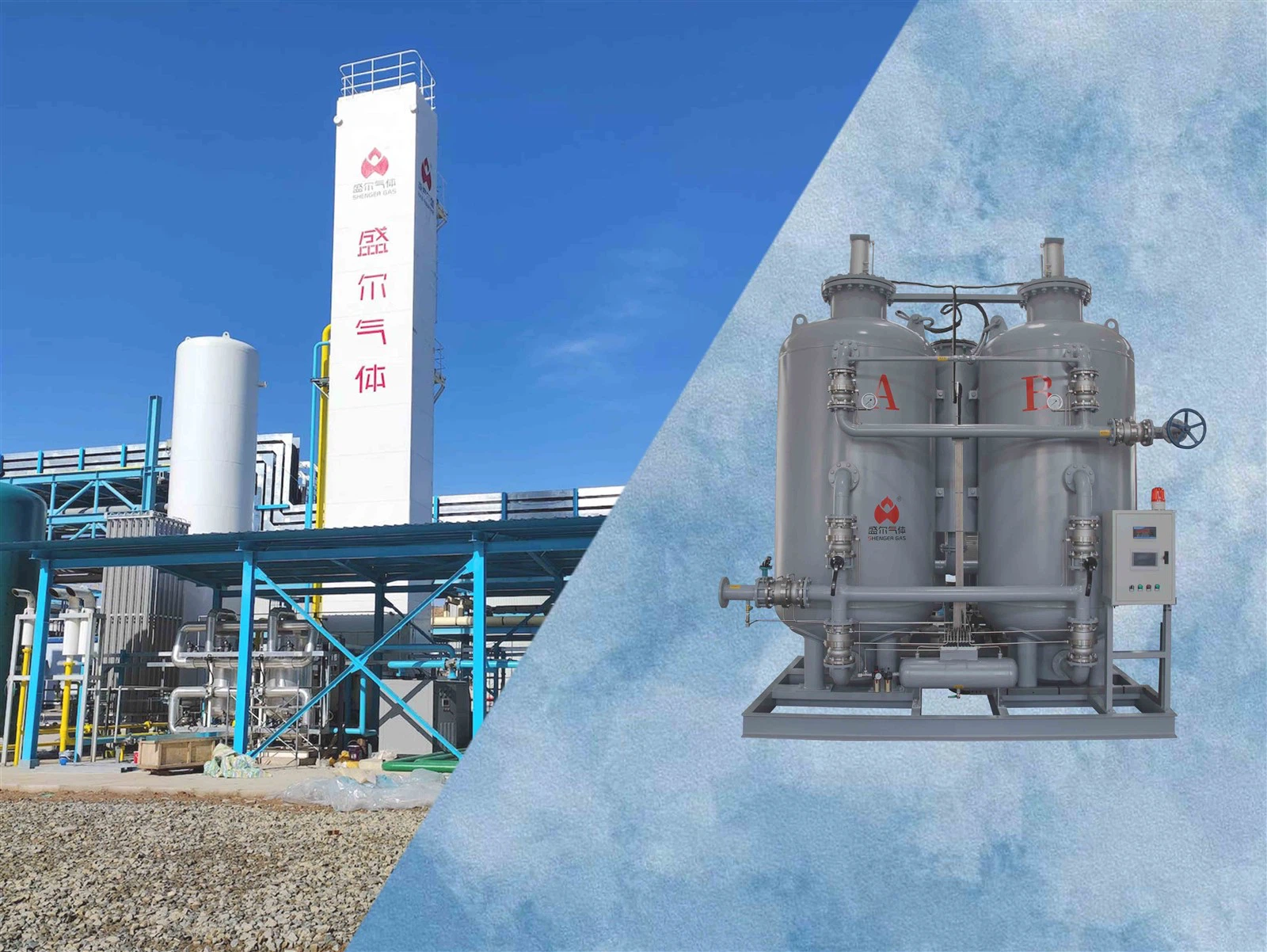
Differences in Nitrogen Generation Principles and Process Routes
1. Cryogenic Nitrogen Production
Cryogenic air separation compresses and purifies ambient air, sends it into a cold box, and cools it down through multi-stage heat exchange to near its liquefaction temperature (approximately −190°C). Due to differences in boiling points of O₂, N₂, and Ar, high-purity nitrogen can be separated in the distillation column.
A typical cryogenic nitrogen production process includes:
- Air compression and pretreatment (oil removal, drying, dust removal)
- Precooling and molecular-sieve purification
- Deep-cold heat exchange through the main heat exchanger
- Fractional distillation and nitrogen purification
- Liquid storage and gas distribution systems
This technology provides excellent separation efficiency, continuous stability, and long-term nitrogen purity up to 99.999%, with the added benefit of co-production of oxygen and argon. It is well-suited for industries requiring extremely high purity and continuous large-scale operation.
2. Nitrogen Generators (PSA / Membrane Separation)
On-site nitrogen generators operate at ambient or moderate temperatures and follow different physical separation mechanisms:
- PSA Nitrogen Generators: Utilize carbon molecular sieve to selectively adsorb oxygen over nitrogen under pressure, and release oxygen during depressurization. The cycle typically ranges from several seconds to a few minutes.
- Membrane Nitrogen Generators: Rely on hollow-fiber membranes where oxygen, moisture, and CO₂ permeate faster than nitrogen, resulting in a nitrogen-rich stream.
Both technologies avoid cryogenic refrigeration, enabling compact equipment layout, higher automation, easier operation, and a rapid startup response. They are commonly used in small- to medium-scale industrial nitrogen supply scenarios.
Investment, Operating Cost, and Footprint Comparison
Cryogenic Nitrogen Production - High Investment, Large Scale
1. Cryogenic systems include an air compressor, precooling system, molecular-sieve purifier, main heat exchanger, distillation tower, liquid storage, and control systems. For projects requiring tens of thousands of tons per year, total investment typically starts from millions of RMB. System footprint can reach thousands of square meters, suitable for industrial parks or integrated petrochemical complexes.
When running at high loads continuously, nitrogen unit cost can be controlled at 0.5–1.0 RMB/Nm³, with further economic benefits when oxygen and argon are co-produced.
2. PSA / Membrane Nitrogen Generators - Lower Investment, Faster Deployment
For example, a PSA system rated at 300 Nm³/h generally includes an air compressor, purification and drying unit, PSA towers, nitrogen buffer tank, and a PLC control panel. Typical investment ranges from hundreds of thousands to over one million RMB, with installation area often below a few dozen square meters.
Energy consumption is mainly from the air compressor, keeping operational cost relatively low. Depending on the configured purity and operating conditions, nitrogen cost can typically remain between 0.2–0.4 RMB/Nm³. This makes PSA and membrane systems highly suitable for small- and medium-scale users with faster payback expectations.
Startup Time, Load Adjustment, and Response Speed
Cryogenic nitrogen systems require the cold box and distillation column to fully reach cryogenic operating conditions before stable output is achieved-this may take several hours or longer. Therefore, they are intended for continuous and steady production, not for frequent start-stop operation.
In contrast, PSA nitrogen generators can start and reach full production within minutes, and membrane systems stabilize rapidly in continuous operation. Their flexibility makes them ideal for applications with fluctuating demand or as backup nitrogen sources, reducing standby energy consumption and minimizing operational disruption.
Applicable Scenarios and Long-Term Economic Considerations
Both technologies have clear application boundaries:
1. Cryogenic nitrogen is preferred when:
- Ultra-large and 24/7 continuous nitrogen supply is required (e.g., steel, coal-to-chemicals, refining)
- Ultra-high purity, low oxygen content, or high-pressure nitrogen is needed
- Oxygen and argon co-production improves overall economics
- The project has long-term planning and strong infrastructure support
Under high-load conditions, cryogenic systems usually provide the most competitive cost per unit of gas and strong reliability.
2. PSA / Membrane nitrogen generation is preferred when:
- Nitrogen demand is small to medium or varies significantly
- Space is limited and rapid commissioning is required
- Purity requirements range from 95%–99.999%
- The facility expands capacity in phases based on future growth
These technologies offer higher flexibility, shorter installation time, and easier O&M, making them cost-effective in many industrial scenarios such as food packaging, electronics, lithium-battery drying, pharmaceuticals, and inerting for warehousing.
Key Technical Comparison
(Typical reference ranges for engineering design)
|
Criteria |
Cryogenic Nitrogen Production |
PSA / Membrane Nitrogen Generators |
|
Nitrogen purity |
95%–99.999% |
95%–99.999% (membrane: typically ≤ 99.5%) |
|
Suitable flow range |
Medium to ultra-large scale |
Small to medium scale; modular expansion |
|
Startup time |
Hours to a full day |
Minutes |
|
Initial investment |
High |
Low to moderate |
|
Installation area |
Large |
Compact |
|
Co-production of O₂ / Ar |
Yes |
No |
|
O&M complexity |
High |
Low |
|
Typical industries |
Steel, petrochemical, refining |
Food, electronics, lithium battery, pharma, storage |
Key Factors When Selecting a Nitrogen Supply Method
Selection should be based on full lifecycle evaluation, including:
- Required nitrogen flow rate and future expansion
- Purity, dew point, and oxygen content requirements
- Load stability or fluctuations in production
- CAPEX vs OPEX priorities
- Whether oxygen or argon co-production is required
- Space, power supply, and maintenance resources
Clarifying these conditions ensures the selected solution aligns with operating efficiency and long-term economic goals.
No Absolute Best - Only What Fits the Application
Both cryogenic nitrogen production and PSA/membrane nitrogen generation are proven technologies. The key is alignment with real industrial requirements and lifecycle economic benefits.
- For ultra-large scale and multi-gas supply → Cryogenic air separation is a reliable option
- For flexible, rapid deployment and moderate purity demand → PSA or membrane systems provide strong advantages
Shenger Gas emphasizes starting from specific operating conditions rather than blindly pursuing higher specifications or lower prices. By matching flow demand, purity levels, energy consumption, and maintenance capacity, we help customers achieve stable nitrogen supply, reduced operating cost, and long-term production reliability.
If you are evaluating nitrogen supply solutions, you are welcome to consult Shenger Gas for detailed configuration and engineering support tailored to your facility.


