


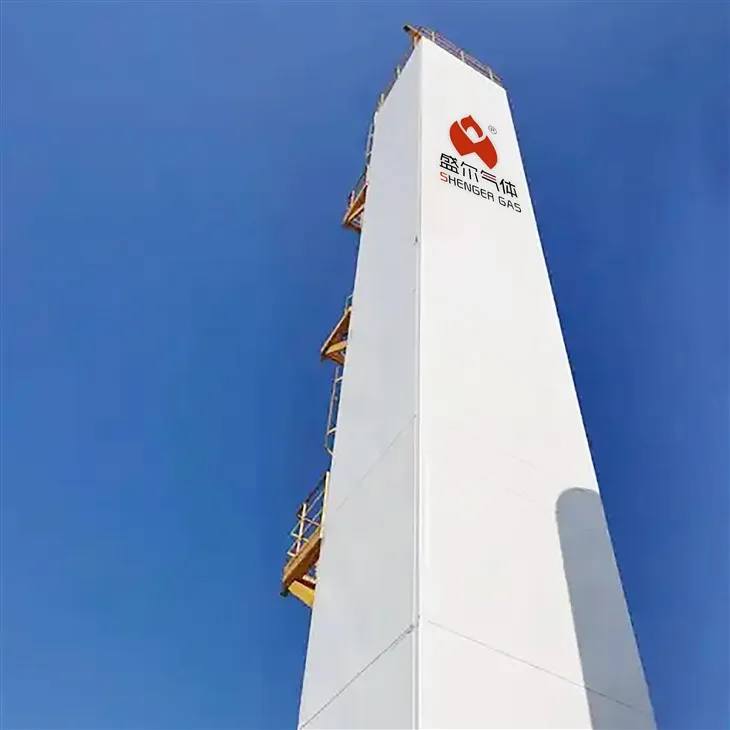
Medical-Grade Cryogenic Air Separation Oxygen Plant
In medical gas engineering, oxygen purity and supply stability directly affect clinical outcomes. For large-scale, continuous medical oxygen applications-such as major healthcare centers, regional oxygen generation stations, or high-altitude hospitals-traditional cylinder or liquid oxygen transport models often face economic and logistical challenges. An on-site medical-grade cryogenic air separation oxygen plant is becoming the core solution for improving oxygen supply security.
How It Works: Precision Engineering Based on Physical Separation
Unlike pressure swing adsorption or membrane technologies, cryogenic air separation uses the significant difference in boiling points of air components. The process follows four stages: compression, purification, heat exchange, and rectification.
- Air Compression & Pre-cooling: Raw air is compressed by a multi-stage compressor, then cooled to about 5–12°C in a pre-cooling unit to remove most free water.
- Purification System: Alternating molecular sieve adsorbers remove residual moisture, carbon dioxide, and hydrocarbons to prevent cryogenic channel blockage. Treated air typically contains less than 1 ppm CO₂.
- Rectification Core: Purified air enters the main heat exchanger and is cooled to near liquefaction temperature (approx. -172°C) by returning gas streams. It then enters the fractionating column where vapor-liquid contact occurs on sieve trays or structured packing. Lower-boiling nitrogen enriches at the top, while oxygen-rich liquid collects at the bottom. Through multiple reboiling and condensation steps, liquid oxygen with purity of 99.5% to 99.7% is produced at the column bottom.
- Product Output: Liquid oxygen is pressurized by a cryogenic pump, then vaporized and warmed to ambient temperature in the heat exchanger, becoming gaseous medical-grade oxygen meeting pharmacopoeia standards.
The entire system operates as a continuous, stable medical-grade cryogenic air separation oxygen plant. Because the separation process involves no chemical reactions, the resulting oxygen is exceptionally pure, odorless, and free from harmful byproducts-fully compliant with stringent medical oxygen standards.
Performance Specifications
| Parameter | Range | Notes |
|---|---|---|
| Oxygen Purity | ≥99.7% (vol.) | Meets medical oxygen standards, no harmful impurities |
| Flow Range | 50 – 2,000 Nm³/h | Modular design; extendable upon request |
| Discharge Pressure | 0.4 – 4.5 MPa(g) | Oil-free booster optional for longer delivery distances |
| Ambient Temp. Range | -15°C to +45°C | Custom insulation or cooling for extreme climates |
| Specific Energy Consumption | 0.65 – 0.85 kWh/Nm³ O₂ | Full load, including compression, purification, and refrigeration |
Energy Consumption & Efficiency Optimization
Energy cost is a key economic factor for any medical-grade cryogenic air separation oxygen plant. Power consumption is distributed mainly across the main air compressor (65–70%), turbo-expander (15–20%), and auxiliary systems. By using high-efficiency radial-flow turbo-expanders, low-resistance structured packing, and intelligent load control, our plant keeps the energy rise within 15% when operating at 50% load. This means you avoid the inefficiency of running full capacity during low-demand hours.
For a typical 300 Nm³/h medical oxygen plant running 8,000 hours annually, the electricity savings compared to a non-optimized design can reach USD 2,000–3,000 per year (based on $0.08/kWh). All rotating components are monitored online for vibration to maintain operation along the optimal energy curve.
Key Technical Parameters (Typical)
- Startup Time (cold to qualified oxygen): ≤ 36 hours (including molecular sieve activation); hot standby restart: ≤ 2 hours.
- Product Dew Point: ≤ -70°C (at atmospheric pressure) to prevent line freezing.
- Noise Level: ≤ 85 dB(A) at 1 meter; ≤ 75 dB(A) with acoustic enclosure.
- Control System: Siemens/DCS redundant PLC, supports automatic variable load (40–105% range), historical data traceability, and remote diagnostic interface.
- Safety Design: Liquid oxygen acetylene monitoring and alarm, explosion-proof main condenser-evaporator, emergency pressure relief and isolation valves.
Industrial Applications
This type of plant is primarily suited for the following scenarios :
- Large integrated medical campuses – Replacing liquid oxygen tank delivery to reduce logistics dependency and cryogenic storage risks.
- Medical centers in high-altitude or remote areas – Eliminating supply interruption risks caused by transport difficulties.
- Medical gas industry facilities – Providing high-purity liquid oxygen for bottling or conversion to gaseous form for medical networks.
- Life science research centers – Supplying ultra-high-purity, batch-consistent oxygen for cell culture or animal studies.
- Emergency health reserve bases – Acting as strategic stockpile equipment for rapid response to public health events.
Customization Capabilities: Beyond Standard Models
Oxygen demand patterns vary greatly across medical institutions-operating rooms, ICUs, hyperbaric chambers, and general wards each have different consumption curves. Therefore, we offer simulation-based customized design:
- Climate adaptation – Larger molecular sieve beds for hot/humid regions; heated instrument lines and anti-freeze heat exchanger measures for extreme cold.
- Site layout – Indoor/outdoor, compact footprint (as low as 80% of conventional size), or skid-mounted for retrofitting older buildings.
- Redundancy – N+1 design for key pumps, valves, and instruments; oxygen storage buffer for maintenance without shutdown.
- Noise & emissions – Fully enclosed acoustic enclosures; no wastewater process (only periodic clean condensate discharge).
Engineering Services: Full Lifecycle Support
We do not provide "as-is drawings." Instead, we offer phased professional services:
- Consultation – On-site assessment of oxygen load, power capacity, and environmental conditions; feasibility report and payback analysis.
- Design delivery – P&ID, 3D layout, foundation loads, and electrical schematics delivered digitally.
- Manufacturing supervision – Major welds, pressure tests, and full factory assembly test (client witness optional).
- Installation & commissioning – Engineer team on-site for guidance; assistance with permits where applicable.
- Training program – Written and hands-on evaluation for operations, maintenance, and emergency response to ensure independent shift readiness.
- Long-term service agreement – Annual inspections, spare parts supply, and emergency response within 8 hours .
Shenger Gas sticks to one simple belief for every medical-grade cryogenic air separation oxygen plant: no compromise on patient-grade purity. Every process - from design to shipment - follows medical standards, not because customers require it, but because we wouldn't accept less ourselves. We still personally check every weld on the liquid oxygen line.


Hot Tags: medical-grade cryogenic air separation oxygen plant, China medical-grade cryogenic air separation oxygen plant manufacturers, suppliers, factory
You Might Also Like


Send Inquiry