What is the oxygen recovery rate of a PSA oxygen plant? Well, let me break it down for you. I'm a supplier of PSA Oxygen Plants, and I've dealt with a whole bunch of questions about these plants, especially regarding the oxygen recovery rate.
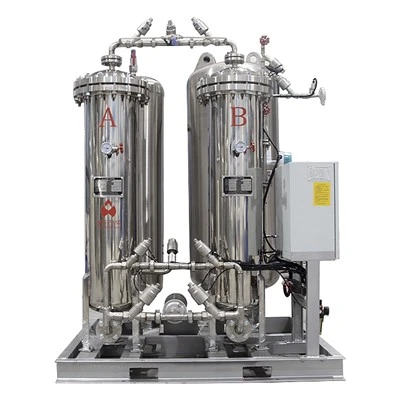
First off, let's understand what PSA stands for. PSA is short for Pressure Swing Adsorption. It's a technology that's used to separate oxygen from other gases in the air, mainly nitrogen. The basic idea behind a PSA oxygen plant is that it uses adsorbent materials to selectively adsorb nitrogen at high pressure and then release it at low pressure. This process allows for the production of relatively pure oxygen.


The oxygen recovery rate of a PSA oxygen plant is a crucial factor. It refers to the percentage of oxygen in the feed air that is actually recovered as product oxygen. In simpler terms, if you have a certain amount of air going into the PSA plant, the recovery rate tells you how much of the oxygen in that air comes out as usable oxygen.
Now, the recovery rate can vary depending on several factors. One of the main factors is the type of adsorbent used. Different adsorbents have different adsorption capacities for nitrogen. For example, some high - performance adsorbents can adsorb more nitrogen, which means a higher oxygen recovery rate. Another factor is the operating pressure and temperature of the PSA process. Generally, higher pressures can lead to better nitrogen adsorption and thus a higher recovery rate, but there are limits to how high the pressure can go due to equipment and safety considerations.
The purity of the product oxygen also affects the recovery rate. If you want a higher purity of oxygen, say 95% or more, the recovery rate might be lower. This is because to get a very pure oxygen product, you need to be more selective in the separation process, which means leaving behind more oxygen in the waste stream. On the other hand, if you're okay with a lower purity, like 90%, the recovery rate can be higher.
Let's talk about some real - world applications. In the medical field, PSA oxygen plants are widely used. Medical - Grade Oxygen Concentrator is a great example. These concentrators need to produce oxygen with a high purity, usually around 93% - 95%. In this case, the recovery rate might be on the lower side, but the high purity is essential for medical use.
For industrial applications, such as metal cutting or wastewater treatment, the purity requirements might not be as strict. So, you can have a higher oxygen recovery rate. For instance, in metal cutting, an oxygen purity of around 90% might be sufficient, and the PSA plant can be optimized to achieve a relatively high recovery rate.
If you're looking for a PSA Medical Oxygen Generator, you need to consider both the purity and the recovery rate. A battery - powered oxygen concentrator is very useful in situations where there's no reliable power supply, like in remote areas or during power outages. But you still want to make sure that it can produce enough oxygen at an acceptable purity.
Another type of PSA oxygen plant is the High Flow Oxygen Generator. These are designed to produce a large volume of oxygen. The recovery rate here is also important, as it affects the overall efficiency of the plant. A high - flow generator with a good recovery rate can save a lot of energy and operating costs in the long run.
As a PSA Oxygen Plant supplier, I can tell you that we always try to optimize the oxygen recovery rate for our customers. We work closely with them to understand their specific needs, whether it's for medical, industrial, or other applications. We use the latest technology and high - quality adsorbents to ensure that our plants can achieve the best possible recovery rate while meeting the required oxygen purity.
If you're in the market for a PSA oxygen plant, don't just focus on the price. Consider the oxygen recovery rate, the purity of the product, and the overall performance of the plant. A plant with a higher recovery rate might cost a bit more upfront, but it can save you a lot of money in the long term due to lower energy consumption and less waste.
If you're interested in learning more about our PSA oxygen plants or have any questions about the oxygen recovery rate, feel free to reach out. We're always happy to have a chat and help you find the best solution for your needs. Whether you need a small - scale medical oxygen concentrator or a large - scale industrial high - flow oxygen generator, we've got you covered.
References:
- "Pressure Swing Adsorption" by Douglas M. Ruthven, Seong H. Lee, and Kaamran R. Knaebel.
- "Oxygen Generation Technologies" in various industry - specific journals and research papers.