


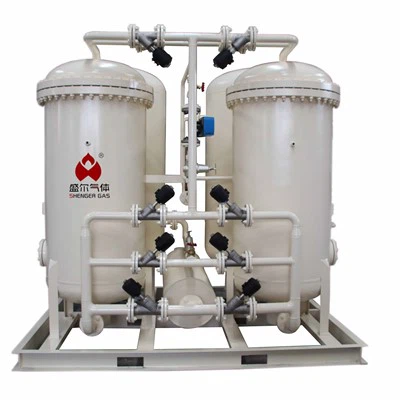
Industrial PSA Oxygen Generator
In the field of industrial gas supply, the industrial PSA oxygen generator has become a core choice for many manufacturing companies looking to reduce liquid oxygen dependency and achieve on-site oxygen generation. Compared to traditional cryogenic air separation or purchased liquid oxygen, pressure swing adsorption technology offers a lower entry threshold and more flexible operation. It is now widely adopted in industries such as metallurgy, papermaking, aquaculture, ozone integration, and glass melting.
How It Works – No Complicated Chemistry
The principle is based on carbon molecular sieves that preferentially adsorb nitrogen under pressure. Two alternating adsorption towers complete a continuous cycle: pressurization and adsorption, followed by depressurization and regeneration. When compressed air enters one tower, nitrogen is captured by the sieves, while oxygen flows through as the product gas. The other tower simultaneously releases captured nitrogen to prepare for the next adsorption phase. The entire process is managed by a PLC-controlled valve switching system. No chemical additives are required, and no harmful byproducts are produced.
The practical result? Stable oxygen purity, low operating costs dominated by electricity consumption, and product gas available within just a few minutes after startup.
Temperature Limits and Energy Considerations
The system is designed to operate within an ambient temperature range of 5°C to 45°C. Below 5°C, residual moisture in the compressed air may freeze inside the molecular sieve bed. In that case, we recommend adding inlet air preheating or a drying pre-treatment stage. Above 45°C, the dynamic adsorption capacity of the sieve decreases. A refrigerated air dryer should be used to keep the inlet temperature below 40°C.
On energy consumption, pay attention to two things: specific power per Nm³ of oxygen, and annual efficiency degradation. Reliable manufacturers quote energy figures based on new molecular sieves under clean conditions. In real operation, if inlet oil content exceeds 0.01 mg/m³ or fine dust remains unfiltered for long periods, the sieves can degrade gradually. Energy consumption may then rise by 8%–12% per year. That's why we install multi-stage filtration and oil removal modules on every system before the air enters the adsorption towers.
Full Technical Parameters (standard containerized model)
-
Adsorption tower material: Q345R boiler steel or 304 stainless steel (selected based on corrosive gas source)
-
Molecular sieve type: Lithium-X or Calcium-X, service life ≥10 years (under non-contaminated conditions)
-
Valve response time: ≤0.5 seconds, solenoid valve cycle life >2 million operations
-
Control system: Siemens S7-1200 or equivalent domestic PLC, 7-inch touchscreen
-
Noise level: ≤80 dB(A) at 1 meter (acoustic enclosure optional)
-
Overall dimensions: Customized based on flow rate; smallest skid approx. 2.2m × 1.8m × 2.5m
Which Industrial Scenarios Truly Need On-Site Oxygen?
Any continuous production facility consuming more than 8–10 tons of liquid oxygen per month, with low tolerance for downtime, should evaluate on-site oxygen generation. Typical applications include:
-
Non-ferrous metal smelting – oxygen enrichment improves flame temperature and reduces heat loss through flue gas.
-
Ozone generator feed – oxygen-fed ozone concentration reaches 100–150 mg/L, 3–5 times higher than air-fed systems.
-
Glass fiber furnace – oxygen-enriched combustion cuts NOx emissions and extends furnace life.
-
Aquaculture – maintaining dissolved oxygen above 5 mg/L in high-density recirculating systems.
-
Pulp bleaching – replacing chlorine-based chemicals to reduce AOX in wastewater.
If your business falls into any of these categories, our engineering team can prepare a clear TCO (total cost of ownership) comparison based on your real consumption pattern.
Certifications and Compliance
Every industrial PSA oxygen generator we ship is designed and tested according to the following standards:
-
Pressure vessels: Compliant with GB/T 150 or ASME Section VIII (export option)
-
Electrical safety: IEC 60204-1
-
Quality management: ISO 9001:2015
-
Hazardous area operation: Ex d IIB T4 (must be specified in contract)
We also assist customers with local special equipment registration where needed.
Customized – Beyond Bolt-On Modifications
Many buyers settle for standard machines and later find that either energy consumption is higher than expected, or the physical footprint doesn't fit their plant layout. Shenger Gas approach is different: parametric customization, not just bolting on extra parts.
You can specify any combination of the following:
-
Oxygen purity from 90% to 95% in 1% increments
-
Flow rate linearly adjustable from 3 Nm³/h up to 500 Nm³/h
-
Containerized, skid-mounted, or open-frame configuration
-
High-altitude adaptation (automatic cycle adjustment above 3,000 meters)
-
Remote monitoring and push alerts via 4G or Ethernet
For customers with unstable compressed air supply, we can also design a buffer tank logic that allows the system to run at reduced load during pressure fluctuations instead of shutting down completely.
Service Commitment – Not Just "Repair When Broken"
- Response tiering: Remote diagnosis within 2 hours. On-site service within 24 hours in East China, and within 48 hours in remote regions.
- Shared spare parts: For all customers under warranty, you can draw from our regional warehouse stock of sieves, valves, and controllers at no charge.
- Old unit buyback: When a system reaches 15–18 years of service life, we repurchase the main steel structure at residual value and offer trade-in credit toward a new unit.
Choosing an industrial PSA oxygen generator is essentially buying a gas plant, not just a piece of equipment. Purity, energy consumption, degradation, and service determine the three-year cost. Shenger Gas helps industrial users bring down oxygen costs. If you're troubled by liquid oxygen price fluctuations or considering whether to invest in a PSA system, feel free to come to us with your gas usage records from the past three months.


Hot Tags: industrial psa oxygen generator, China industrial psa oxygen generator manufacturers, suppliers, factory
Previous
No InformationYou Might Also Like



Send Inquiry