


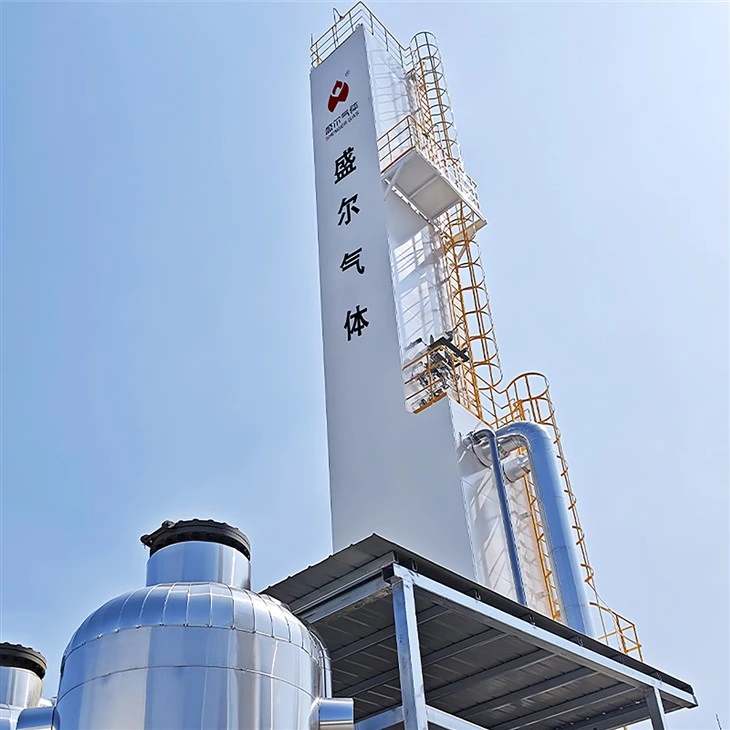
On-Site Cryogenic Air Separation Unit
In the industrial gas supply chain, the reliable acquisition of gaseous oxygen, nitrogen, and argon has long depended on external procurement or large-scale centralized air separation plants. For operations with fluctuating consumption patterns, high transportation costs, or stringent purity requirements for specific processes, an independently operated On-site cryogenic air separation unit is increasingly recognized as a more controllable and economically viable alternative. In essence, it is a miniaturized, modular air separation factory built directly at the point of use, which physically separates the components of atmospheric air to enable on-demand production and immediate supply.
Fundamental Operating Principle
This equipment operates on the basis of cryogenic rectification technology, which exploits the differences in boiling points among oxygen, nitrogen, and argon (approximately –183°C, –196°C, and –186°C, respectively). The overall process can be summarized in four sequential stages: compression, pre-cooling, purification, expansion refrigeration, and rectification.
- Air Compression and Pre-cooling: Ambient air undergoes multi-stage compression, after which it passes through a pre-cooling unit to reduce its temperature to 5–12°C, condensing out most of the free water content.
- Purification System: The pre-cooled air enters a molecular sieve adsorber, which removes residual carbon dioxide, hydrocarbons, and trace moisture, ensuring that the air entering the cold box is dry and clean (CO₂ ≤ 1 ppm).
- Refrigeration Generation and Rectification: The purified air flows into the main heat exchanger, where it is cooled by returning cryogenic gas streams to a temperature approaching liquefaction. It then enters the rectification column-typically a double-column arrangement-where mass and heat transfer occur between rising vapor and descending liquid. High-purity nitrogen is obtained at the top, while liquid or gaseous oxygen is drawn from the bottom, and argon fraction is extracted from the middle section and further refined in a crude argon column.
- Product Delivery: Depending on system configuration, final products can include industrial-grade oxygen (99.6% purity), high-purity nitrogen (99.999%), and argon (99.999%), all delivered either in gaseous form or as cryogenic liquids to the user's internal pipeline network.
Throughout this process, cold balance is critical-the refrigeration capacity generated by the expansion turbine must exactly compensate for the system's cold losses to maintain stable rectification conditions. Compared with pressure swing adsorption or membrane separation technologies, the On-site cryogenic air separation unit offers significantly higher separation efficiency and is particularly suitable for medium-to-large-scale gas demand (typically 100 to 3,000 Nm³/h) where constant product purity is essential.
Key Performance Parameters (Typical Reference Range)
| Parameter | Specification Range |
|---|---|
| Product Purity | Oxygen ≥ 99.6%; Nitrogen 99.999% (O₂ ≤ 1 ppm); Argon 99.999% |
| Flow Rate (Nm³/h) | Oxygen 200 – 3,000; Nitrogen 300 – 5,000 (adjustable) |
| Delivery Temperature | Ambient (environmental temperature +5°C) or cryogenic liquid (–183°C / –196°C) |
| Start-up Time | Cold start ≤ 4 hours; Hot (first-ever) start ≤ 36 hours |
| Specific Power Consumption | 0.38 – 0.45 kWh/Nm³ (oxygen basis, including compression, pre-cooling, and purification) |
| Cooling Water Makeup | Closed-loop circulation, typical makeup 1.5–2.5 t/h (depending on ambient conditions) |
| MTBF (rotating equipment inside cold box) | ≥ 8,000 operating hours |
Note: The above data are based on standard reference conditions (ambient temperature 30°C, relative humidity 80%, at sea level). Actual performance will vary with altitude and local meteorological conditions; final values should be confirmed by process calculations.
Technical Characteristics and Energy Efficiency
Compared with liquid oxygen truck delivery or piped utility gas, the On-site cryogenic air separation unit offers the fundamental advantage of synchronizing production with consumption-this eliminates transportation losses, storage tank evaporation losses, and exposure to market price fluctuations. In terms of energy performance, the use of high-efficiency turbo-expanders and aluminum plate-fin heat exchangers limits cold-end losses to below 8%. The integrated automatic variable-load regulation system adjusts the air feed rate and product extraction ratios according to downstream demand, maintaining rectification efficiency across a 50%–110% load range without degradation.
Additionally, the molecular sieve purification system is regenerated using waste nitrogen heated by a dedicated heater, eliminating the need for external steam or additional electric heating elements, thereby further reducing overall utility consumption. For sites that require simultaneous access to oxygen, nitrogen, and argon-for example, in stainless steel annealing, electronic soldering, or chemical blanketing applications-the system enables multi-product output from a single installation, avoiding duplicated capital expenditure.
Industrial Application Fields
- Metal Processing and Heat Treatment: Oxygen used for combustion-assisted cutting and oxygen-enriched combustion; nitrogen used for annealing protection and furnace purging.
- Chemical and Petrochemical Industries: Nitrogen serves as a purge gas and reactor blanket; oxygen is used for oxidation processes or off-gas treatment.
- Electronics and Semiconductor Manufacturing: High-purity nitrogen functions as a carrier gas and cleaning gas; argon is used in physical vapor deposition processes for wafer fabrication.
- Food and Pharmaceutical Sectors: Nitrogen applied in modified-atmosphere packaging and freshness preservation; liquid nitrogen used for cryogenic grinding or freeze-drying pre-cooling.
- Glass and Building Materials: Oxygen employed in glass furnace oxy-fuel combustion to reduce NOx emissions.
Configuration Scope and Technical Support
Each installation site differs in terms of electricity cost, cooling water temperature, altitude, and required gas delivery pressure. A site-specific process design is therefore standard practice: starting from the feed air composition analysis, incorporating full-year meteorological data, through to cold box layout, pipe routing, and control system interfacing-all dimensions are determined according to the actual conditions. Standard equipment scope typically includes:
- Distributed Control System (DCS) with remote monitoring interface
- Sequential start/stop logic for one-button operation
- Fault self-diagnostic alarm system (covering bearing temperature, vibration, liquid level, and purity deviations)
- Spare parts package (molecular sieve, filter cartridges, instrument valve diaphragms, etc.) delivered together with the main unit
Technical support includes on-site commissioning guidance and operator training over a two-week period following mechanical completion. For capacity expansions, the system is designed in a modular fashion-the cold box, pre-cooling skid, and purifier vessels can all be factory-fabricated, requiring only on-site connection of piping and electrical cabling, thus significantly reducing civil works duration.
The On-site cryogenic air separation unit offered by Shenger Gas represents a fully engineered solution that covers process simulation, energy modeling, installation supervision, and long-term operational maintenance. With over a decade of deep‑cryogenic project experience, the engineering team has accumulated proven expertise in skid‑mounted configuration, automatic load‑following control, and low‑energy‑consumption design. For applications with a gas demand exceeding 200 Nm³/h and with strict purity and pressure specifications, a feasibility study including an estimated payback period can be provided to ensure that every cubic meter of gas is accounted for and utilized with full economic transparency.


Hot Tags: on-site cryogenic air separation unit, China on-site cryogenic air separation unit manufacturers, suppliers, factory, Cryogenic Liquid Nitrogen Plant
You Might Also Like


Send Inquiry